Planning Reform 2024 Update: What UK Planners Need To Know About The NPPF

It's a busy time for planners, developers, and local authorities - with the newly-elected Labour government releasing the details of their mission to 'kickstart economic growth' in the UK.
More recently, we've seen a proposal for a substantial rework of the National Planning Policy Framework (NPPF), which Labour views as key to unblocking the rollout of new infrastructure. It's currently in open consultation as the government hears feedback from citizens and stakeholders, with a final version expected to be released in September, 2024. The NPPF provides guidance to local authorities in England on how to make the best planning decisions - incorporating factors like sustainability, economic growth, community well-being, and environmental protection. The NPPF was last updated in 2023 by Michael Gove, as part of the Levelling Up and Regeneration Bill.
On this page, we'll walk you through the new changes to the NPPF under Labour, and what it means for local planning authorities, developers, and regular citizens.
Labour's proposed Planning Reform bills

Over the past few weeks, we've already seen some major policy papers and announcements coming out of Westminster. In fact, you've probably noticed a few of these headlines in the news:
- The Creation of a New Towns Taskforce: Labour plans to designate sites for a new generation of new towns within the next 12 months, signalling an approach to development not seen since the 1970s. It's expected that these large-scale communities will have at least 10,000 new homes each, and will lie on transport corridors with existing rail and road links to larger cities.
- A Planning and Infrastructure Bill in the King's Speech: Though the fine print has yet to be released, this bill promises to modernise planning committees, provide new resources for local authorities, and take a proactive approach to nature recovery.
- A Lift on the Ban on New On-Shore Wind Farms: The construction of on-shore wind farms halted following strict restrictions in 2015. Labour reversed this decision in their first week of office, and the changes are reinforced in the latest iteration of the NPPF.
- New Powers for Local Government: The Planning and Infrastructure Bill will give councils more leeway to acquire private land for affordable housing under a reworked compulsory purchase order scheme. The new model will ensure payouts are "fair but not excessive".
- New Powers for Central Government: Deputy Prime Minister Angela Rayner announced that she "will not hesitate" to intervene if councils fail to meet housing targets, with a possible rework of the intervention criteria on the cards.
The NPPF update introduces new mandatory housing targets
Labour's infrastructure plans centre around supply-side economics (i.e. increasing the number of new homes being built) - and it's easy to see why.
The UK is currently in the grips of one of the worst housing crises in the OECD, with analysis by the Resolution Foundation revealing that British housing stock offers the worst value for money of any advanced economy.
Our homes are old, small, and energy-inefficient. And the truth is, we're just not building fast enough to keep up with our growing population. National statistics show that just 234.4K new homes were built in 2022-2023, far short of the previous target of 300K per year (which will soon be increased to 370K per year under Labour).
So, to ramp up housebuilding efforts, the NPPF is introducing mandatory housing targets along with new mechanisms to enforce them (Ch1, 3a). This effectively reverses the advisory system implemented by the Sunak administration in 2022.
How local authorities are expected to reach Labour's housing targets
All local councils will now have to select appropriate sites where developers can build new homes - reaching the target set by the central government - with the aim of rapidly achieving universal local plan coverage. Currently, just a third of councils have plans that are less than 5 years old, meaning the majority were created according to out-of-date criteria.
The new house building targets have been distributed according to a recalibration of the Standard Method - a formula that looks at where housing is most needed in the country. Previously, this formula applied a 35% 'urban uplift' to targets in the top-20 most populous LPAs.
Labour's NPPF proposes to scrap the urban uplift and replace it with a stronger housing affordability multiplier (Ch4, 7b). In practice, this means London's target has decreased by almost 20K homes per year, with some places in the North having almost doubled. You can see the specific changes for your area using the interactive graphic produced by Lichfields below.
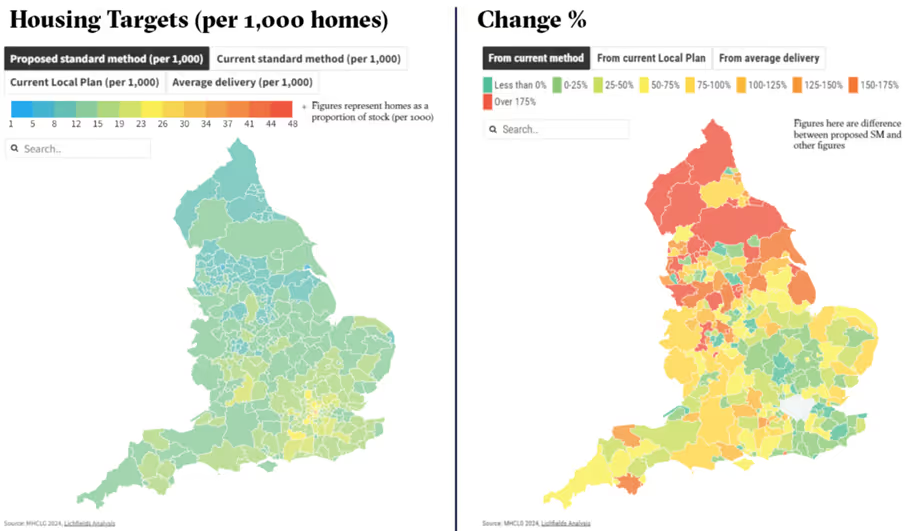
Citizen engagement plays a central role in how new housing sites are selected, with local authorities being obligated to consult the public when making decisions of achieving best value. The government also recognises that this process is time-consuming and resource intensive. So, the NPPF promises direct funding support to LPAs facing significantly higher housing targets under the new plans (Ch12, 7).
A new look at land use: Brownfield, Grey Belt, and the Green Belt

You've probably heard of the terms 'brownfield' and 'Green Belt' before. Brownfield being the disused, derelict land that's expensive (but important) to regenerate, whereas greenbelt conjures up imagery of the sacred countryside.
For years, governments have tried to encourage brownfield development while striking down most planning proposals in the Green Belt. This was certainly the theme of Gove's NPPF, and indeed the latest NPPF reaffirms a default "yes" to any brownfield development. However, with a housing crisis and ambitious new infrastructure targets, the government is getting creative with their approach to the Green Belt.
What is the Grey Belt?
What if I told you parts of the Green Belt weren't actually so green and pleasant? This land, termed the 'Grey Belt', is open for business under the new NPPF update (with a few caveats). We're talking sites like old petrol stations or car parks on the very edge of suburbia, as well as parcels of land that aren't so aesthetically pleasing...
Here's the definition they went with (Ch5, 9):
Grey belt: For the purposes of Plan-making and decision-making, grey belt is defined as land in the Green Belt comprising Previously Developed Land and any other parcels and/or areas of Green Belt land that make a limited contribution to the five Green Belt purposes...
The government favours a sequential test for development in the Green Belt, where previously-developed land (PDL) should be released for development first. Once that has been considered, local authorities could designate land as Grey Belt if it doesn't strongly perform against any Green Belt purpose (e.g. preventing urban sprawl), and has at least one of the following features:
- Land containing substantial built development or which is fully enclosed by built form
- Land which makes no or very little contribution to preventing neighbouring towns from merging into one another
- Land which is dominated by urban land uses, including physical developments
- Land which contributes little to preserving the setting and special character of historic towns
Planning Reform and the Green Belt
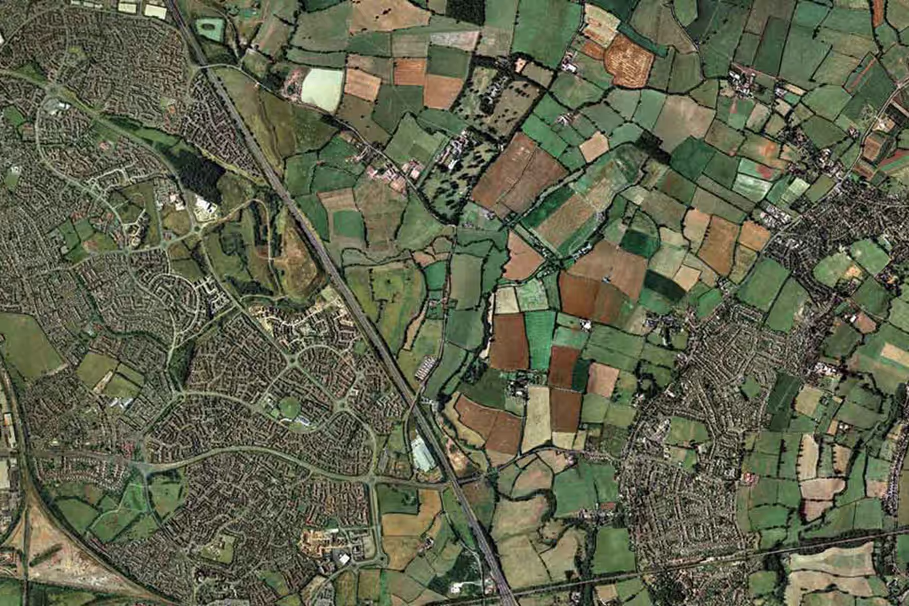
It doesn't stop there. The NPPF update, 2024 states that the Green Belt could also be developed on in specific circumstances where land could be used for sustainable development (e.g. land surrounding train stations). And going beyond plan-making, the government also supports release of some Green Belt land when councils fail to meet mandatory housing targets and developers present strong proposals for areas they believe to be Grey Belt.
Releasing the Green Belt for development is a big deal - after all, some of this land has been protected since 1947 (or even earlier for London). In recognition of this, the NPPF proposes some 'golden rules' to ensure development benefits both communities and nature. These are:
- Housing schemes in the Grey Belt should have at least 50% affordable homes.
- Necessary improvements should be made to public infrastructure, including new schools, GP surgeries, transport links, care homes, and nursery places.
- Local green spaces should remain accessible within a short walk of new residents' homes.
Of course, any plan-making on Green Belt land will require open consultation with the public and stakeholders on how to achieve best value. For such complex projects relating to transport corridors and new public infrastructure, interactive geospatial mapping and surveys can be a lot more intuitive for regular folk to grasp and see the changes from a bird's eye view.
It's also important to note that these changes do not aim to undermine existing protections for the most versatile agricultural land in the Green Belt, and won't change the planning permission system for such areas.
NPPF's proposed changes to Nationally Significant Infrastructure Projects (NSIP)

As part of the government's broader industrial strategy, the NPPF hones in on changes that would further support the development of "knowledge, creative, high technology and data-driven sectors" (Ch7).
Under new rules, the local planning authority would need to identify suitable locations for laboratories, gigafactories, and data centres - and to also consider the unique supply chains required to maintain these sites.
But perhaps the most significant proposed change relates to the Nationally Significant Infrastructure Projects (NSIP) regime. The government is exploring whether to enable developers of digital infrastructure projects to "opt-in" to the NSIP's streamlined consenting process. In practice, this would shift responsibility for approving large-scale projects away from local planning authorities and to the relevant Secretary of State. Such a top-down approach could mean faster delivery of exceptional projects, subject to the NSIP's unique consultation process.
Supporting community services within the NPPF
A similar emphasis is placed on hastening the development of key public services infrastructure (Ch8). The NPPF proposes giving significant weight to projects like hospitals, prisons, schools, and childcare facilities - a term that isn't taken lightly in planning.
Essentially, the presumption will be that these projects are approved unless very strong reasons are given otherwise. It's hoped that this change will reduce the burden on public infrastructure, which was a major theme of Labour's election campaign.
The government is also trying to think more long-term about transport planning, disavowing what they term the 'predict and provide' model. In particular, they want to give priority first to pedestrian and cycle movements; and second, to facilitate access to high-quality public transport.
Doing so, they argue, will promote more active lifestyles, which in turn would further reduce the burdens on public services like healthcare. Local authorities will therefore be expected to review travel plans for all developments that would generate significant amounts of movement (including new housing sites) - a task made significantly easier with digital planning tools that incorporate geospatial data to create interactive local maps for development.
Tackling renewable energy production planning
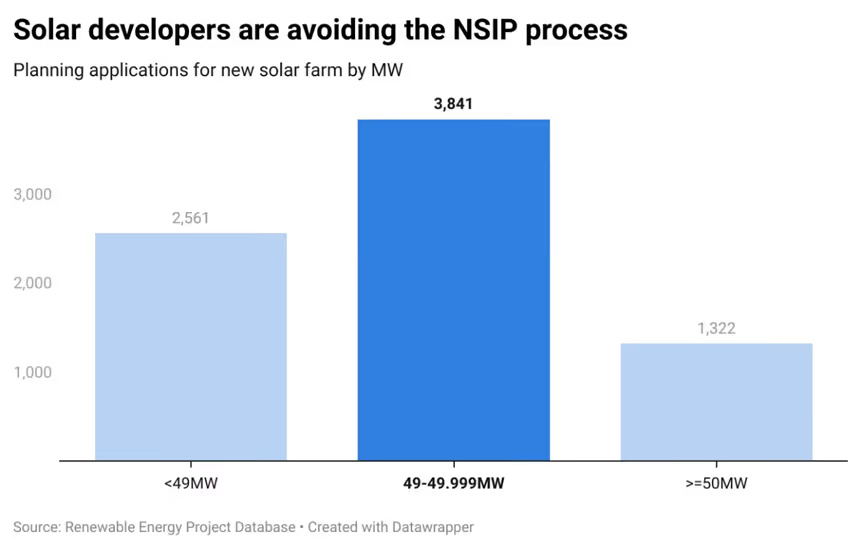
The NPPF takes a slightly different approach when it comes to the construction of renewable energy infrastructure (Ch9). Under the current system, all solar and onshore wind projects with a generating capacity of more than 50 megawatts are determined by NSIP rules.
Solar panels and wind turbines are much more efficient these days, meaning it's cheaper for developers to build big. Sam Dumitriu of Britain Remade noticed a trend of solar farms clustering at 49 megawatts to avoid the NSIP process altogether - suggesting that smaller developers prefer navigating the standard planning permission route to the bureaucracy of central government. This represents a bit of a blockage on the creation of renewable energy projects necessary to transform the UK into a clean power nation.
So, the government has done some tinkering around the edges by increasing the NSIP threshold for onshore wind to 100 megawatts, and solar projects to 150 megawatts. Labour hopes this will encourage wider deployment of smaller, more geographically spread-out projects - which, in theory, could result in faster consenting at a lower cost for developers.
From beautiful to useful: Local design codes replace subjective monikers in the NPPF
Beauty? It's all in the eye of the beholder...
The revised NPPF has a lot of new rules for planning authorities and developers to follow, but it also drops some old rules entirely. Perhaps most striking is the removal of all references to "beauty" and "beautiful". No longer will these terms guide development in England - the rationale being that they are simply too subjective and lead to inconsistent decision-making (Ch6, 18).
Instead, the government advocates the National Model Design Code (or where available local design codes) as hallmarks of assessing and improving the design of development.
Utility? It's a bit more objective...
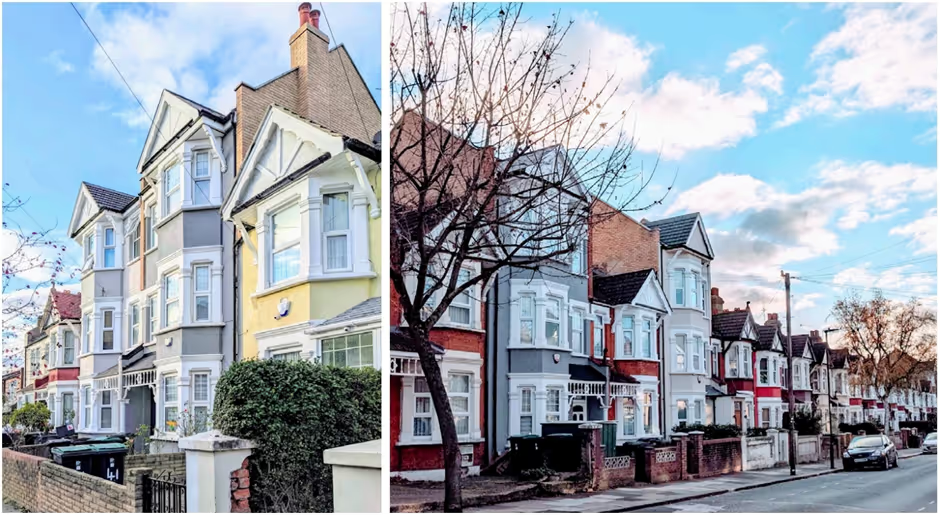
The latest NPPF also loosens restrictions for homeowners to extend their properties upwards. In Gove's version eight months ago, planning authorities were instructed to almost always allow mansard roof extensions where one property on the street was already of the same height. Labour seems to be even more sympathetic to the idea, with the scope being shifted from mansard roofs to all types of upward extension, and dropping the 'second-mover' requirement with regards to height. As long as the extension matches the prevailing form of an area, it's considered fair game (Ch6, 21).
This continues the trend seen in London following a 2016 consultation on a new class of permitted development rights that were ultimately rolled out in 2020. Some London boroughs, such as Haringey Council, have been very encouraging of this type of 'gentle density' where housing is most needed, as long as it harmonises with the design of the existing building. Rory Stewart, former minister for the Environment, notes that:
"Victorian houses have been extended upwards so deftly that the casual observer would not know that the extensions were new. This is exactly the sort of thing the Victorians would themselves have done."
Local planning authorities will receive more government funding
The UK's planning system is marred by a chronic resourcing shortfall, and it's slowing down the rate at which local authorities can approve new projects. This has pretty severe knock-on effects, because all of these changes to the NPPF will be in vain if no one at the council has time to properly review applications - and let's be honest, that's not a great look to potential investors.
Under the current system, just 9% of LPAs are determining >70% of non-major applications within 8 weeks; and it's even worse for major projects, with less than 1% of LPAs meeting their statutory deadlines.
So, the new NPPF planning reform suggests two new routes for funding to be made available to local authorities, proportionate to the caseload of planning applications and projects in their jurisdiction (Ch11):
- Increased Planning Application Fees: Existing fees for many application types, particularly householder applications (which comprise 52% of all applications), fail to cover the actual processing costs. To address this, the new NPPF proposes a substantial increase in householder application fees, from £258 to £528, aiming to achieve full cost recovery.
- Cost Recovery for NSIP Engagement: Currently, local authorities involved in the NSIP process (for projects like large-scale energy infrastructure) cannot recover their costs for engaging with applicants, even though they often provide essential input. The NPPF proposes enabling "host authorities" to charge fees on proposed projects to cover these costs, ensuring that nationally-significant projects don't come at the expense of local interests.
Conclusion: How Labour's NPPF July update changes planning
To wrap up, the UK's plan-making system is set for a significant overhaul under the revised National Planning Policy Framework - which is absolutely necessary if the government is to meet its ambitions for housing, renewable energy, and economic growth. The transition to this new system, however, will be carefully managed, with transitional arrangements in place to accommodate emerging local plans at various stages of development.
One thing is clear: regular citizens will continue to play a big role in spatial planning and the future of their neighbourhoods. Now, the onus is on local government to step forward and engage effectively according to the new rules.
You're not alone, though. With tools like Citizen Space, it's easier than ever for planning authorities to collect public feedback and create beautiful, digital local plans. Our platform is the government's preferred route for receiving consultation responses on this NPPF, enabling a more efficient and effective consideration of the issues raised
No one can predict the future, but some trends are self-evident. The government shares our view that digital is the future, and has hinted that future changes to the NPPF will include a more accessible and interactive web-based set of national policies. So, there's never been a better time to get started with our online consultation tools.