Gove's 2023/4 NPPF Plans
This article is now out of date. Click here for the latest information on Labour's planning reforms and the NPPF update
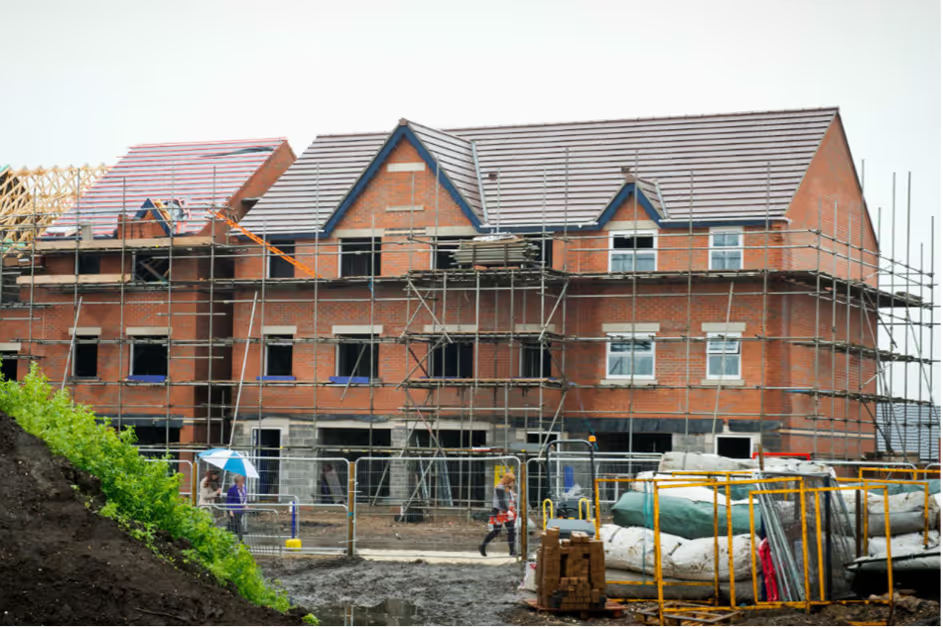
It's another big year for planning reforms in England, with a broad scope of changes taking place that hasn't been matched since the introduction of the National Planning Policy Framework in 2012.
The government's broad aims are:
- To build 300,000 new homes per year by the mid-2020s
- To fully decarbonise the power sector by 2035
- To boost productivity, pay, jobs, and living standards
- To future-proof the country's infrastructure for climate change
If you think those sound like ambitious targets, you'd be correct, and there's an equally ambitious legislative backdrop that seeks to make achieving them possible. Local governments and developers need to be aware of the following key rule changes that are reshaping how we approach development in this country.
Planning reform and changes in 2024
The Levelling-up and Regeneration Act (LURA), 2023: This is a huge piece of legislation that mostly came into effect in December 2023. It completely shakes up the planning process and introduces several new powers to national and local government:
- A new Infrastructure Levy reworks how developers contribute to large construction projects. For instance, a developer building a high-end apartment complex would also need to pay for improving public services within the area.
- Local planning authorities (LPAs) are now mandated to establish design codes, determining the location and aesthetic of new housing developments to ensure quality and consistency.
- At the wider scale, National Development Management Policies (NDMPs) will standardise issues common across areas.
- A new power enables authorities to refuse any planning application from developers with a history of slow build-out rates.
- The introduction of Street Votes for local residents to initiate proposals for redeveloping their own homes.
- The enforcement period for breaches of planning control will be extended from four to ten years.
The Future Homes Standard: This was kickstarted by a 2019 consultation into the national Building Regulations, as part of government plans to address the climate emergency. The report recommended modernising building codes to improve ventilation/energy efficiency. From 2025, the stricter standard will come into effect - requiring new-builds to use 75% to 80% less energy to heat than those built before 2019. Developers will have to adapt their construction strategies accordingly, perhaps opting to construct more multi-unit residential buildings over single-unit homes.
Review into the role of Statutory Consultees: This review, initiated by Michael Gove and led by Sam Richards of Britain Remade, aims to reform the role quangos play in planning approvals. Currently, some environmental and heritage projects are subject to decisions by bodies like Natural England and the Environment Agency. The proposed changes could potentially lead to the introduction of a 'green tape' system, where the absence of a response within a 21-day timeframe could be interpreted as agreement, rather than an obstacle, to the project going ahead.
Prioritisation of Freeports: This comes alongside a 'Freeports Delivery Roadmap' that encourages local authorities to grant tax/customs privileges in key economic zones like ports or airports.
Revisions to the National Planning Policy Framework (NPPF): This document guides LPAs on how to adhere to sustainable development principles. The latest update in December 2023 was initiated when LURA came into effect - setting out a new agenda that local councils must follow when preparing local plans and making decisions on planning applications.
On this page, we'll specifically focus on the recent changes to the National Planning Policy Framework and what it means for planning authorities in England.
Infrastructure Projects 2024
Planning for today, tomorrow and in the future
Let's talk about the driving force that's behind many of the changes to the NPPF - the concept of spatial infrastructure planning.
This is the idea that planners should take a holistic approach to infrastructure development and neighbourhood planning - that things like transportation networks, utilities, and public services should be built in the right places to achieve optimal land use. That way, our communities have the necessary amenities to grow naturally over the long term, without the need to rethink town designs every decade.
Planners will already have a good idea of what effective spatial planning involves. It means creating a system where it's easy for people to get around, businesses get plenty of foot traffic, and industrial zones/transit corridors are kept well away from living areas. It aligns with those development aims that the government is aspiring to - boosting local economies and fostering a sense of community.
Using Delib for digital planning
While we're on the topic, let us explain how spatial planning works in Citizen Space. Our software provides a platform where a local authority can publish interactive maps of upcoming developments in their area. Common topics include info on potential spots to build a new transport hubs, national parks, or shopping centre. Local people and stakeholders can click on the local plan and leave feedback - giving planners access to enriched response data.
Citizen Space empowers planners to create a customised blueprint for the future. It does this by inviting local residents into the conversation, as these are the people who know their area best and who development is meant to serve.

Building a strong, competitive economy
It doesn't take an economist to explain the causal relationship between infrastructure and economic growth.
Building good schools means your workforce will turn out educated and productive. The more office space you build, the cheaper it is for businesses to move in. And when you build transport links, people can easily get to the places they need to be. This creates the perfect conditions for businesses to invest and thrive.
The National Planning Policy Framework recognises these factors and puts pen to paper on how to achieve them. It urges authorities to establish a clear economic vision for sustainable growth through the creation of Local Industrial Strategies, as well as five-year and ten-year development plans. It recommends that:
- Rural areas should aim to diversify their economies through land-based tourism and leisure developments. To reflect the higher barrier to investment, planners must prioritise the retention of accessible rural services and transport facilities.
- Deprived areas should encourage mixed-use developments to bring people together - boosting economic activity by having commercial and residential zones within walking distance of each other.
- Productive areas like city centres should lean into their strengths and promote sector-specific growth. For instance, creating business clusters for tech or creative industries that are capable of attracting the brightest minds and competing on the world stage.
To spur these developments, the NPPF suggests identifying key strategic sites that represent the most lucrative opportunities for economic growth and regeneration. We'll explore what sort of areas are meant by this in the next section.
Making effective use of land
The government is keen for local authorities to engage in spatial infrastructure planning to maximise economic output from developed land.
Michael Gove, the Minister for Levelling-Up, has repeatedly signalled his preference for building denser cities, which would cut commuting times and create liveable communities with easy access to public amenities. He also wants to incentivise a 'brownfield-first' approach to development, with the reasoning that:
"Communities expect us to make use of empty properties or disused buildings, and redevelop existing derelict sites, before we consider building on other land."
These ambitions are reflected in the guidance given to local councils in the latest revisions of the NPPF. For instance, it instructs local planning authorities on the following:
- Planners should assess local market conditions to determine the appropriate density for real estate development - particularly paying attention to the capacity of transport infrastructure and public services.
- Under-utilised space should be earmarked for priority development, including flats above shops, and areas above car parks, service yards, and railway infrastructure.
- Where possible, opportunities should be taken to encourage the upward development of properties, such as allowing mansard roof extensions in residential areas.
This trend of relaxing planning laws is expected to continue in upcoming changes to the NPPF. For instance, the DLUHC announced in February that new rules would allow commercial property (such as restaurants, shops, or offices) to be converted into residential dwellings without the need to seek prior planning permission - something known as "permitted development rights".
Likewise, the government intends to consult on allowing houses to be converted into two flats, as long as the exterior remains unchanged. This planning decision should contribute to overall housing availability and would be especially useful to fill demand near public transport corridors and zones of high economic activity.
Climate Change, Conserving & Enhancing Natural and Historic Environments
Another key aspect of land usage that the NPPF addresses in its planning policy statement is the relationship between human and natural environments.
The document takes the position that new developments shouldn't infringe upon green spaces or the existing character of a local community, but rather contribute to its preservation. It encourages local planners to adopt these strategic positions when drafting their economic vision for a local area:
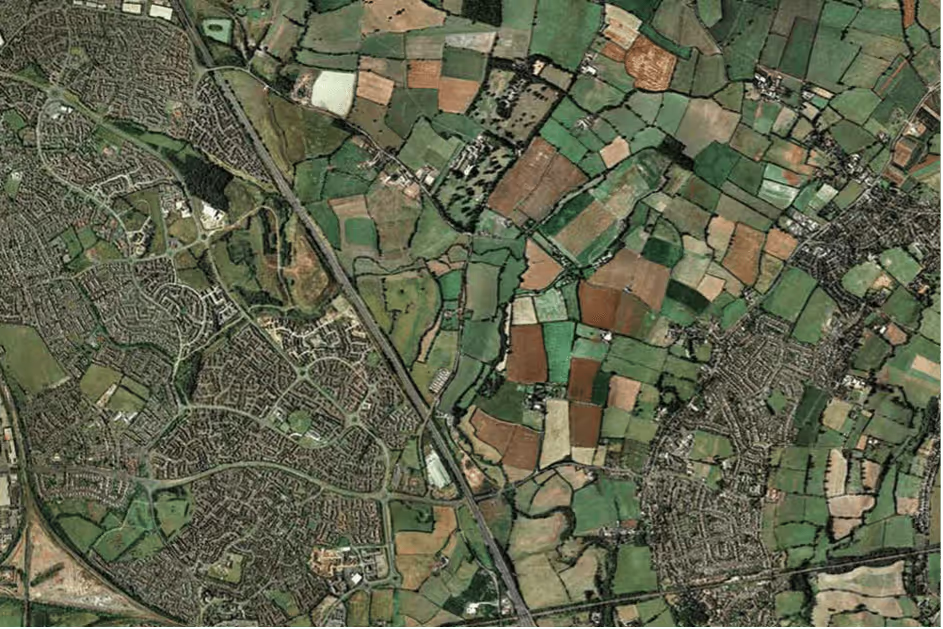
- Undeveloped land isn't a bad thing; it serves many purposes from providing a habitat for wildlife, to providing humans with recreational space, flood risk mitigation, carbon storage, and food production. Green belt land should therefore only be built upon in exceptional circumstances.
- Many brownfield sites are derelict, degraded, or contaminated; and would be the perfect places to regenerate and use for housing development.
- The local planning authority should address the significance of heritage assets (including as-of-yet unidentified cultural sites) and aim to conserve their historic environments - thus preserving the character of these locations for future generations.
- Area-based character assessments should inform local design guides and planning codes, again ensuring that the local culture of a community is not lost.
In addition to these NPPF rule changes, the government plans to consult on removing restrictions surrounding the placement of heat pumps and electric vehicle charging points. If implemented, homeowners and developers could install these devices without the need to apply for planning permission - in theory, accelerating private development of green infrastructure on the route to Net Zero carbon...

Future reform? Labour's proposed changes to the NPPF
As of late-July 2024, the British people have voted the Labour party into power for the first time since 2005. One of the key priorities of this new government, according to Keir Starmer, is to transform the UK into a nation of "builders, not blockers". They see the current planning rules as a barrier to economic growth that make it too difficult to build houses and approve major projects.
To remedy this, a "Planning and Infrastructure Bill" has been proposed in the recent King's Speech. Once the bill is introduced to parliament later this month, we'll have a full view of the details (so be sure to watch this space!). Until then, here's a brief overview of the agenda:
Faster Renewable Energy Roll-Out: The bill will aim to fast-track the approval process for Nationally Significant Infrastructure. Under the current system, 85% of energy projects face delays connecting to the National Grid, often pushing completion into the late 2030s and threatening the UK's Paris agreement targets. Labour has already lifted the nine-year ban on new on-shore wind farms, and their upcoming reforms to the NPPF will attempt to accelerate private-sector projects in this area.
Compulsory Purchase Reform: Changes to compulsory purchase compensation rules are coming. The government wants a system where payouts are "fair but not excessive", which they claim will help developers access the best sites for new affordable housing.
Increased Capacity for Local Authorities: Local planning departments are feeling the strain, with the vast majority of both major and non-major developments not being approved in the statutory timeframes. Labour promises to hire 300 new planners and lift housebuilding restrictions on poor quality areas of the green belt - AKA 'grey belt' land - which they view as key to hitting their target of building 1.5 million new homes in the next 5 years. They also plan to "modernise planning committees", although the details of this scheme have not yet been released.
A New Approach to Nature Recovery: The bill suggests a new framework for ecological conservation in urban areas and the countryside. Doing so, they argue, would be a "win-win" for both the economy and the environment. For instance, cleaner air and water quality would mean less strain on the NHS, and rewilded land could help reduce flood risk in built areas. Labour intends to consult with nature charities and the private sector to find the sweet spot for these new rules.
Conclusion
To summarise, it's imperative that local planning authorities adhere to the NPPF while also considering their own design codes and the interests of local citizens.
For starters, public bodies that don't comply risk having planning decisions overturned on appeal and may face external intervention, undermining local control over development initiatives.
But perhaps more importantly; the NPPF is meant to restore public trust in the planning process and create communities that are happy, healthy, and economically active. Planners need to meet those expectations and invite local residents to join the discussion - because without their input, development becomes disconnected from the very people it is designed to serve.
Sign up for the Delib newsletter here to get relevant updates posted to your email inbox.
---
Citizen Space is the go-to platform for connecting governments with citizens. If you'd like to learn more about how our software streamlines public engagement and provides planners with enriched geospatial data, book a free demo and we'll walk you through it.