Improving Engagement With Residents & Tenants

Getting tenant and resident engagement right is essential for any reputable housing provider, particularly local councils and large housing associations. Not only is engaging residents a legal requirement that can be costly to get wrong, when done well it can be very beneficial to both residents and providers.
Why resident and tenant engagement matters

Whether through a housing association, a housing co-op or a local authority, tenant and resident engagement has never been more important. Gone are the days where providers were only expected to meet a minimum, statutory obligation to keep residents and tenants informed. Instead, many residents now expect to be actively engaged by their housing provider, and even have a say in shaping the decisions made on their behalf.
Examples of decisions tenants and residents may wish to have a voice in include:
- Allocation policies.
- Estate management.
- Site maintenance.
- Tackling ongoing issues, like service provisions or antisocial behaviour.
- Planned repairs and upgrades.
As of April 2024, the Transparency, Influence and Accountability Standard requires all registered housing providers to provide accessible information to residents, regularly consult tenants, anticipate and respond to the needs of tenants and have a clear process for complaints. Not engaging tenants and residents fully therefore has potential legal ramifications. However, good engagement has more potential benefits than just meeting a legal requirement.
With a good resident engagement strategy, decisions around these key issues will be made with a far greater understanding of the potential impact on those who live there. Better engagement leads to better outcomes. For residents and tenants, engagement opportunities ensure that their concerns and desires are heard and have an influence on the planning process. For providers, it reduces the likelihood of disputes, complaints and subsequent delays.
Understanding the needs of the local community

All effective citizen engagement aims to achieve two things:
- To provide affected stakeholders with detailed, accurate and accessible information on an issue that affects them.
- To allow decision-makers to understand the needs, desires and beliefs of those affected stakeholders.
Neither works without the other. Just giving information without a clear way to give feedback doesn't allow residents to have their say. Asking questions without providing relevant context leads to biased information, poor quality input, or encourages participation only from a narrow group of already engaged individuals.
In order to fully understand the needs of the local community, particularly residents and tenants, it is necessary to take a mix of different approaches. Rarely are residents a single, homogenous group with the same needs. Priorities will vary considerably between households, as will what is required to encourage resident involvement in the decision-making process.
Traditional surveys can be useful for capturing broad sentiments and common issues in a given area. More hands-on activities, like workshops, panels and focus groups can be used to provide more in-depth qualitative responses that create a more nuanced understanding.
Face-to-face outreach, particularly residents meetings and TARA groups remain essential. However, in 2025 the planning, delivery and output of these engagement activities can benefit considerably from the growing ubiquity of digital engagement platforms.
Govtech tools for tenant and resident engagement

There are few aspects of our lives that haven't been touched in some way by the digital transformations of the last two decades. We are all more connected than ever before, with an almost endless amount of information available to us instantly.
This is no less true for developing tenant and resident engagement strategies. In the last ten years, govtech tools aimed at increasing public engagement have significantly changed how we interact with public bodies and public-facing organisations.
Using a govtech platform considerably reduces the administrative burden of many of the tasks associated with engaging residents. It allows housing providers to:
- Publish residents and tenant consultations to a searchable dashboard.
- Provide an unlimited amount of supporting documentation, including contextual information and data.
- Invite multiple forms of feedback, including quantitative and qualitative answer structures, geospatial data use, and file uploads.
- Analyse responses using in-built analytics or export to external software for more specific analysis.
- Feedback results to respondents, demonstrating transparency.
Govtech platforms like Citizen Space make traditional resident consultation simpler and more efficient. Used well, this can considerably free up the resources previously used to conduct them. This allows housing providers to focus their energies on improving their engagement strategy by taking a more participatory approach.
Participatory approaches to housing management

A participatory approach asks residents and tenants to become active participants in shaping the policies and decisions made on their behalf. It asks them to not only give their views on specific questions set by decision-makers, but instead to put forward their own thoughts and ideas. What a participatory approach looks like can vary considerably depending on context:
Community mapping
One of the best known examples of "participatory" engagement is community mapping. Mapping activities allow housing providers to demonstrate plans, policies or projects spatially, allowing residents to more easily visualise them.
The activity, which uses geospatial data, also allows residents and tenants to represent their own ideas spatially. For example, if a housing provider were consulting on creating more child-friendly spaces, a community mapping activity might invite residents to plot where they thought would be suitable for a new park.
Used alongside traditional response formats, community mapping can be very helpful for both housing providers and tenants in ensuring a mutual understanding of a given space.
Participatory budgeting
Another commonly used technique is participatory budgeting. Better known in the context of local government, participatory budgeting invites people to look at funding and funding areas themselves, assigning where they think public money ought to go. It is useful for both helping decision-makers understand the priorities of the public, and encouraging the public to understand the difficulties associated with budgeting decisions more clearly.
In the context of a housing provider, whether a housing association or council-run social housing, it has a similar use-case. When budgets are released for repairs, improvements and updates, participatory budgeting can demonstrate where residents and tenants want their money to go. Money earmarked for a community centre may be better spent on a community garden, or vice versa. Management may assume footpaths are an issue when actually residents are more concerned with external doors. Participatory budgeting allows decision-makers to understand fully what residents want and why.
Collaborative service design
Workshops, forums and other collaborative activities bring residents, tenants and housing providers together to develop solutions. By deliberating on issues in an open format, this collaborative approach can be used flexibly to address whatever the key issues are for those residents at that time.
For example, a housing provider may decide to run a workshop on how housing is allocated in the area. Residents may be invited to consider all the issues that the housing provider may wish to consider. Level of need and locality, relationships to existing tenants, etc. They may then discuss how they believe these should be weighted and why. Together, participants and the housing provider can come to conclusions that suit both sides. By conducting these discussions in an open format, residents and tenants develop trust in the process.
Inclusivity and accessibility
Key to any meaningful engagement activity, and particularly a participatory one, is to design with inclusion and accessibility in mind. An activity that can only be accessed by a few, particularly when those few are those who already have a voice, is neither useful nor fair. Instead, the differences that tenants and residents represent should be considered.
This means:
- Offering information in plain English across multiple formats.
- Provide translation where necessary, particularly if there is a high number of certain language groups represented.
- Use networks within the community to reach out. For example, the relevant TARA.
- Ensure that any digital tool or platform follows current accessibility standards.
How to measure resident and tenant engagement success

Measuring the success of engagement is more than just counting how many people have filled out a form or clicked on a link. It also depends on the quality of feedback, the breadth of involvement and the impact participation has had on a given project.
How exactly to quantify success will depend on the exact detail of a consultation, but some common indicators include:
- Was there involvement from individuals from all key stakeholder groups?
- Was there involvement from individuals from all represented demographics?
- What was the quality of responses like? Having some short responses is fine, but if all responses are short, don't deal with the matter fully or seem to contain misconceptions, it may be that residents weren't provided with enough information to participate fully.
- Did the engagement activity tangibly affect a plan or project, and if so, can that be demonstrated?
- Do residents appear to trust the process? A key way to show this is to see if they are willing to participate again in the future.
Monitoring success and then building on areas for improvement is vital to any ongoing tenant or resident engagement strategy. If a certain group isn't represented, it might mean going back to the drawing board and deciding how best they can be engaged for future activities. Generally speaking, the wider the participation, the more successful the engagement.
Case study: Edinburgh Housing
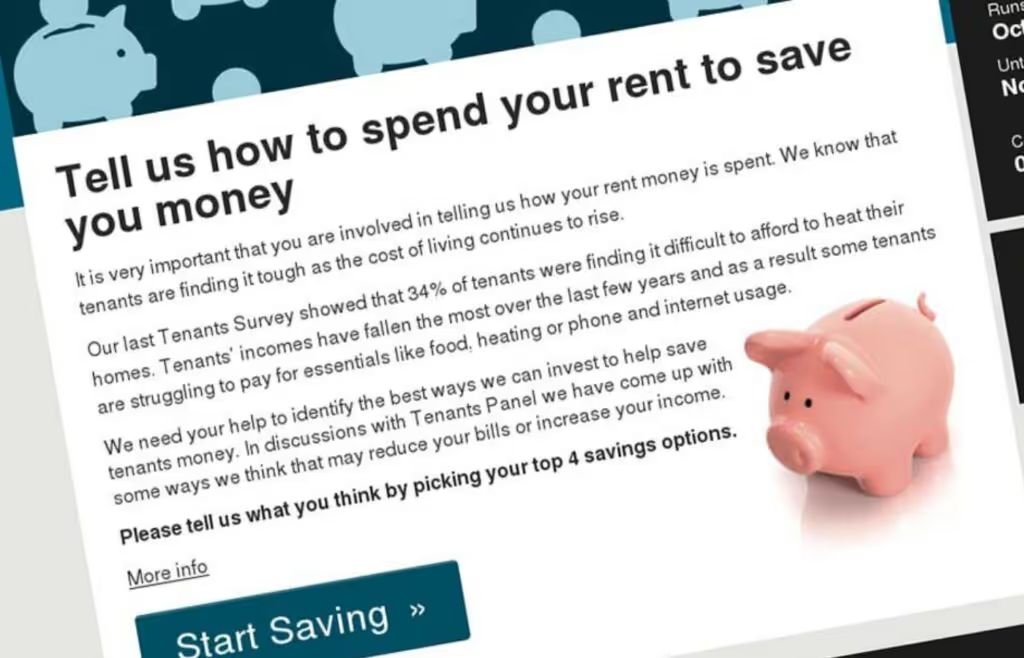
The City of Edinburgh Council's Housing and Regulatory Services department wanted to engage council tenants on how their rent money should be spent. Traditional consultation methods weren't working and tenants had little trust in the process or belief that their input would be heard.
They needed to try something new, so the council tried Simulator, an online tool by Delib that enabled residents to set priorities for housing investment. Tenants explored different ways their money could be invested, like giving tenants loans for insulation costs.
The Council had previously had serious issues with engaging some groups and demographics, but after taking a participatory approach using Simulator, their response rate was three times higher than in previous consultations.
"What impressed me most was how quickly the product was turned around. As a result, I was able to engage with my target audience ahead of the live date and to ensure it was user-friendly, to encourage the maximum response rate."
- Senior Project Manager, The City of Edinburgh Council
Citizen Space is the go-to platform for connecting governments, developers, and citizens. If you'd like to learn more about how our software can be used to engage residents, book a free demo and we'll walk you through it.