Co-creating an equality strategy with Kingston residents using Citizen Space

The challenge
Kingston set out to create a new Inclusive Kingston Strategy for 2025 to 2029, setting the council's equality, diversity and inclusion commitments for four years. A strategy like this only carries weight if it is genuinely shaped by the communities it serves, and Kingston was determined that this one should be built with residents rather than for them.
That ambition brought real challenges. An equality strategy needs to hear from the widest possible range of voices, including the very groups who are often hardest to reach: people facing language barriers, residents who are digitally excluded, disabled people, young people, faith communities, and others who can be missed by conventional consultation.
The council needed not just to count views but to understand lived experience, and to do so in a way that was demonstrably inclusive and accessible. It also wanted to engage in two stages, first to shape the draft objectives and then to test them, so the process needed to support a sustained conversation over many months.
The approach
Kingston ran its online engagement Citizen Space over two phases spanning 20 weeks. More than 700 people actively contributed between the autumn and summer, supported by a multi-channel campaign that reached far wider still, generating over 100,000 views, clicks and interactions across social media and newsletters.
Citizen Space surveys captured structured, comparable feedback. In phase one (November to January), an online survey running on Citizen Space asked residents how well they felt the council listens, celebrates diversity, keeps people safe, and provides accessible services, along with a question on their sense of belonging. In phase two (May to July), a further survey gathered views on the resulting draft objectives. Because respondents could provide equality data as part of the survey, the council could analyse the diversity of its respondents while the engagement was still live.
That live demographic data drove smarter, more inclusive outreach. This is where the approach really stands out. Rather than waiting until the end to discover who had been missed, the council monitored response demographics during the engagement and used them to target promotion at under-represented groups, for example using Snapchat advertising to reach younger residents. The result was feedback from individuals across all protected characteristics and most of the council's priority groups, including communities that often face barriers to participation.
Crucially, the Citizen Space activity sat alongside extensive face-to-face work: 27 community conversations with groups ranging from the Kingston Faith and Belief Forum to the Roma and Irish Traveller community, Korean senior citizens, young carers and a learning disability and autism scheme, plus youth engagement using a specially designed board game, a university campus stall, and drop-in events.
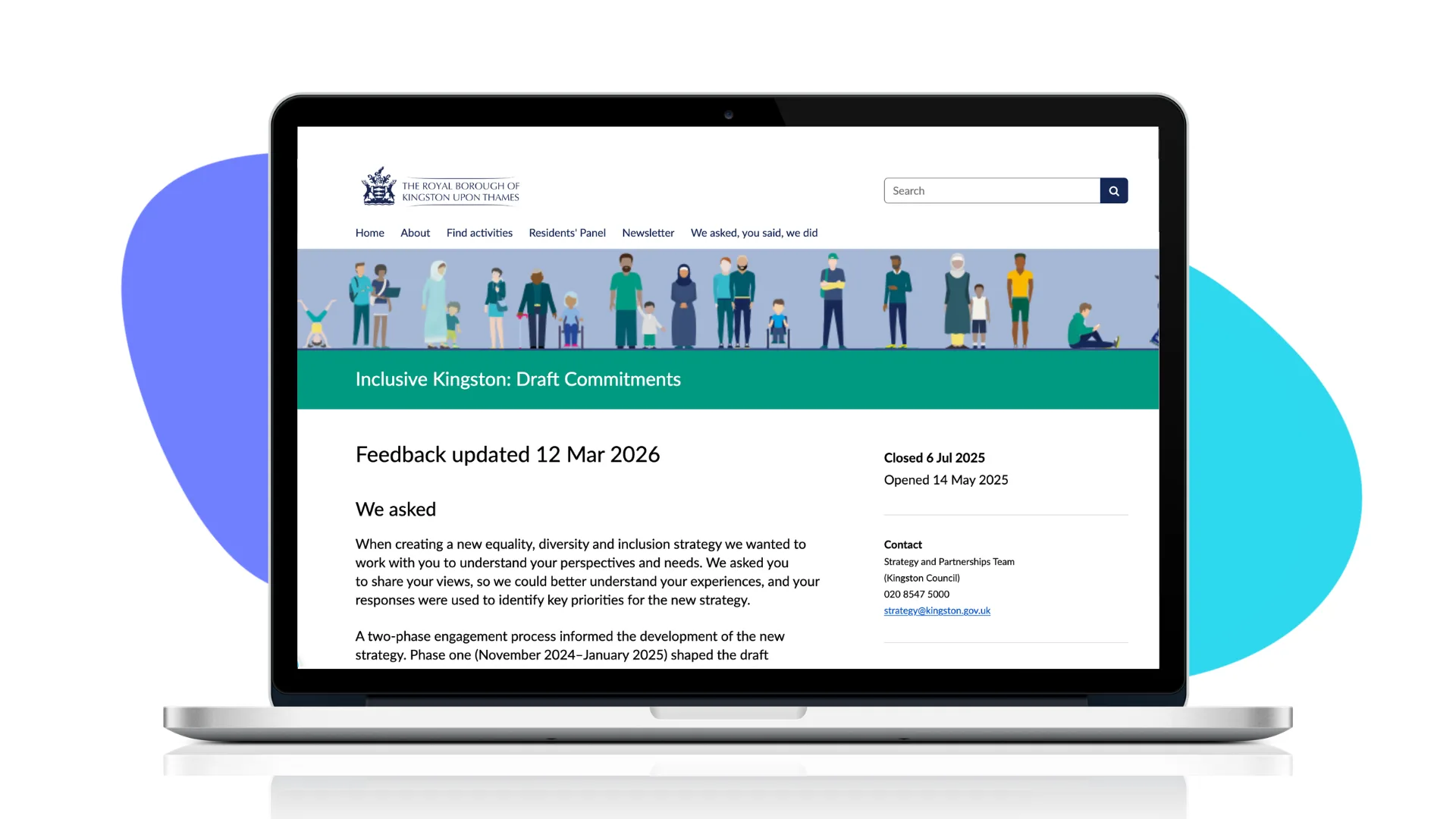
How Kingston responded
Around 450 people contributed through community conversations and 255 through the individual surveys, and the platform gave the council a consistent backbone for pulling this rich, varied input together.
The engagement produced a clear picture of both strengths and gaps.
On what is working well, residents repeatedly praised the borough's celebration of its cultural diversity, the council's effective partnerships with the voluntary, community and social enterprise sector, its health and wellbeing initiatives, and the quality of its adult social care. As one resident put it, "the council does well in celebrating the diversity of the borough's people and cultures".
On where to improve, several themes emerged: residents wanted the practical, everyday relevance of equality and inclusion to be clearer; they called for enhanced community safety, including in parts of Kingston town centre; and they highlighted real difficulty reaching the right council service, particularly for those without digital access or facing a language barrier. The cost of living, street accessibility for disabled people, and a desire to feel that their voice genuinely influences decisions all came through strongly.

How the feedback shaped the strategy
The clearest measure of this engagement's success is how directly it fed into the final strategy. The Inclusive Kingston Strategy 2025 to 2029 was built around four equality objectives, each traceable to what residents said:
- A commitment to deeply understanding communities and acting on their feedback, responding directly to residents' wish to feel heard.
- A commitment to tackling inequality and tailoring approaches to diverse needs, addressing concerns about cost of living, language and digital access, and disability.
- A commitment to being a proudly diverse borough that is inclusive, accessible and safe, answering the feedback on community safety and physical accessibility.
- A commitment to building an inclusive workplace, recognising that a fair organisation is better able to serve its communities.
In direct response to the feedback, the strategy also took on a stronger focus on tackling poverty and a greater emphasis on community cohesion. The council's Corporate and Resources Committee approved the strategy on 27 November 2025, and Kingston published a detailed engagement summary report alongside it, setting out the approach, the stakeholders, the demographics and the outcomes.
Closing the loop
Kingston did not stop at gathering views. It published a full engagement summary report and an accessible strategy, including an Easy Read version, so residents could see how their input had been used. The strategy's foreword thanks everyone who contributed and frames the document explicitly as shaped by residents' voices, and the council has committed to reviewing the work every year. That visible line from contribution to commitment, and the promise of ongoing review, is exactly what turns a consultation into genuine co-creation.
Why it matters
Kingston's approach is a strong example of inclusive engagement done well, and of digital tools amplifying rather than replacing human connection. Citizen Space provided the structured, two-phase surveys that produced comparable feedback and, critically, the live equality data that let the council see who it was and was not hearing from, then act on it mid-process to reach under-represented group
For a diverse, fast-changing borough determined to build its equality strategy with its communities, that combination of structured digital engagement, real-time inclusivity data, and deep partnership working is what made genuinely representative, actionable engagement possible.
Delib is a govtech leader specialising in consultation and engagement, trusted by over 600 government organisations worldwide, including major planning projects. Since 2004, we've been building secure, accessible digital platforms to make participation simpler, fairer, and more inclusive. Our flagship product, Citizen Space, was built in collaboration with the UK government and has supported more than 11 million responses across over 110,000 democratic activities.