Thinking about how to do public engagement "Manchester style"? We've got you covered

"Manchesterism" is suddenly everywhere in British politics but if you strip away the Westminster drama, underneath sits a practical question that long predates any leadership race: if you want to make decisions with people rather than about them, where do you start?
Helpfully, two documents lay out a remarkably clear answer between them: the Greater Manchester Participation Playbook, commissioned through GM Live Well, Greater Manchester’s public services, voluntary sector and communities, and The Productive State: A Framework for Manchesterism by Mathew Lawrence and Alex Williams. The playbook in particular is a genuinely excellent, practitioner-built resource, and credit is due to the writing committee of GM-based participation experts who put it together. Below we've pulled out the takeaways we think matter most for anyone doing this work, with a few notes on how the right tooling makes them achievable.
1. Start with the loop, not the launch
The single most useful idea running through the playbook is that engagement doesn't end when you collect responses. It ends when people see what changed. The participatory budgeting model it sets out has four stages: propose, share, decide, and crucially deliver, where those involved "later feed back on what was achieved." The playbook is explicit that tracking and sharing outcomes is "crucial for transparency, trust and encouraging ongoing involvement."
Our advice: design your close-the-loop step before you launch, not after. Decide up front how and where you'll publish what you heard and what you did about it.
In Citizen Space this is built in: response publishing and "we asked, you said, we did" updates in the same place as the original activity, so the outcome sits right next to the question that prompted it so you can close the loop in a frictionless way.
2. Match the method to the question
A standout feature of the playbook is that it doesn't push one technique. It lays out a whole toolkit (participatory budgeting, participatory grantmaking, citizens' assemblies and juries, legislative theatre, participatory design, digital democracy, community reporting) and is clear that "these tools are flexible" and form "a participatory eco-system" you can combine. It even sketches a sequence: a Long Table event to surface concerns, then a process to gather proposals, then participatory budgeting to decide where money goes.
The takeaway: pick the method to fit the decision, not the other way round. Some questions need the deliberative depth of an assembly. Many more need a well-designed survey, a call for evidence, or a structured consultation that reaches thousands rather than dozens. The art is knowing which is which, and having a platform flexible enough to run the full range, from a simple form to a complex, logic-routed statutory consultation with embedded maps.
3. Design out the barriers from the start
The playbook's core values are worth printing out and pinning up. The ones that translate most directly into practical design choices:
- Honour diversity and inclusion: actively remove barriers to participation, whether that's translation, accessible venues, or accessible tools.
- Use the right tools, including digital: use online platforms where they make participation easier or reach more people, but choose ones that are genuinely accessible.
- Stay flexible: no one-size-fits-all; adapt to the people, place and context.
The playbook is also refreshingly honest that digital is not automatically inclusive. It warns that online tools "must be applied carefully to ensure they don't present further barriers, due to lack of access to devices, internet or digital literacy," and recommends pairing digital processes with in-person support. That's exactly right. Accessibility can't be a checkbox at the end; it has to be a design principle from the first screen. It's why we stress test Citizen Space to WCAG 2.2 AA and treat accessibility as a continuous part of development rather than a one-off audit.
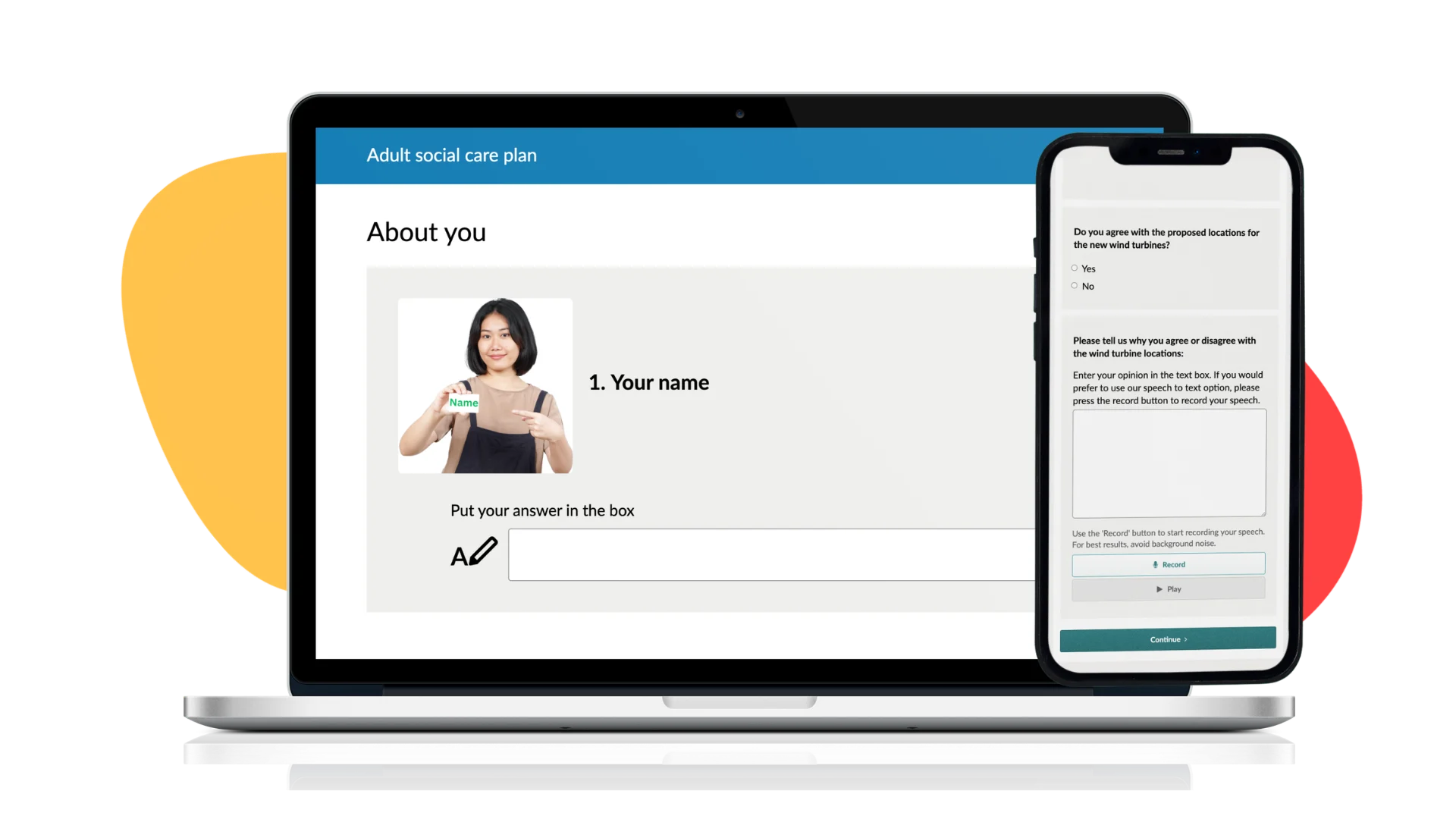
It's also why we built Participation Plus+, our Citizen Space add-on for inclusive design: it includes a speech-to-text function and a dedicated Easy Read activity template, so you can publish an inclusive version of your document and have people respond to it natively in the platform, rather than downloading and filling in a PDF. The point isn't the specific feature, though; it's the principle, which holds whatever platform you use.
4. Treat reach and representativeness as the goal, not raw response counts
One of the most striking examples in the playbook is the Lancaster climate engagement work, where a digital tool gathered over 41,000 votes from more than 520 residents and fed the findings into deliberative workshops. The number that matters there isn't just the votes; it's that online and in-person methods were stacked deliberately to widen who took part.
This mirrors something we hear constantly from our own customers. One council told us that the thing they were proudest of in a transport consultation wasn't the high response rate; it was securing a "more demographically representative sample," which let them inform policy with confidence. When you're planning engagement, set a representativeness goal alongside a volume goal, and use your channels and tools to chase the people you're not hearing from.
5. Budget for participation properly, then watch the cost fall
A practical detail many teams miss: the playbook recommends allocating 5–10% of the total programme or service budget to the participatory process itself, covering facilitation, participants' time, venues, materials and follow-up. But it pairs that with an encouraging observation: once an organisation has run a participatory process a few times and the methods become second nature, "participation gets easier and cheaper over time."
There's a clear lesson for tooling here too. Much of what makes engagement expensive is repeated manual effort: rebuilding the same survey structures, re-running the same analysis by hand, coordinating across disconnected teams. Standardising on shared templates, reusable question sets and built-in analysis is how you bank that "easier and cheaper over time" dividend, turning one team's hard-won expertise into something the whole organisation can reuse.
6. Make the analysis as rigorous as the outreach
It's easy to focus all the energy on getting people to take part and run out of steam when the responses land. But the credibility of the whole exercise rests on what happens next. The Productive State essay's warning about accountability running "outward to communities" rather than "upward to ministers" has a quiet operational implication: the analysis has to be transparent, defensible, and traceable back to what people actually said, especially for statutory processes that may face legal challenge or close public scrutiny.
In practice that means: a clear audit trail from raw response to published finding; the ability to turn qualitative answers into something you can report on without losing the nuance; and outputs that stand up when a senior stakeholder, or a judge, asks how you reached your conclusions. This is the part of the craft that's least visible and most important, and it's where good tooling earns its keep.
The thread running through all of it
If there's one idea connecting these six points, it's that "engaging people" is not a single act but a discipline: design the loop, choose the method, remove the barriers, chase representativeness, resource it properly, and analyse it rigorously. Do those things consistently and you build the thing the source material keeps coming back to: trust.
That discipline is exactly what we exist to support. We're not in the business of taking political sides; we're in the business of making sure that whenever a government, a council or a combined authority decides to involve people, the professionals doing that work have a secure, accessible, trusted platform to do it well, at scale, and with the loop closed at the end.
If you're thinking about doing engagement "Manchester style," or any style, and want to talk through the practical craft of it, we'd love to hear from you.
Delib is the UK's leading independent provider of consultation and engagement software for government. We build the tools, like Citizen Space, that help public-sector teams run the dialogue between citizens and government. To see our platforms in action, book a demo.