The Future of Patient-Centred Care: Public Consultations in Australian Healthcare

The Australian healthcare system is one of the best in the world, and you'll consistently see it topping the rankings along with countries like Singapore, South Korea, and Norway.
What makes Australia fairly unique in this company, is that it happens to be a federal state. That means power is shared between three tiers of administration:
- The Commonwealth Government in Canberra
- Six federal governments (plus two territories)
- 537 local councils
That's not to mention a distinct system of Aboriginal governance that operates alongside these tiers, giving Indigenous communities a voice in policies and services that affect them.
When it comes to healthcare, responsibility is shared, too - with some services run by certain tiers, and some jointly delivered.
The only reason a unified and universal healthcare system is possible in Australia, is through a strict commitment to co-operation, transparency, and accountability, with a focus on patient-centred care.
How Australia is reforming its patient experience

Now, as we move forward into a post-covid world, the Australian health service is pursuing a bold strategy to radically improve national health and care outcomes. In fact, we're seeing the biggest raft of reforms since the introduction of Medicare Australia over forty years ago. If successful, it would mean more efficient services, prevention of the worst illnesses, and more Australians living happy, productive lives.
The overarching theme of these reforms is to shift healthcare policy away from its current focus on providers (i.e. the various tiers of government, hospitals, chemists, pharma companies etc), and towards a patient-centred care system and value based care. And, as you may expect, this effort has largely come through consultation and patient engagement in healthcare - i.e. asking people how they perceive health services, rather than simply relying on clinical data alone.
On this page, we'll walk you through the legislative reforms happening in the Australian health services, and particularly, how the government is using online consultation to meet the expectations and patient needs of every Australian.
The impact of the NHRA

For too long, healthcare decisions have been made about patients, rather than with them. That's the crux of the problem that the National Health Reform Agreement (NHRA) set out to solve.
Historically, Australian health services - split between Commonwealth, state, and territory governments, as well as various private and community groups - often struggled to deliver truly cohesive and person-centred practice. The landmark NHRA, signed by all Australian governments in 2020, changed things by getting every state and territory onto the same page.
What is the NHRA?
The NHRA broadly reworks the mechanism for how Australia's public hospital system is governed and financed. The idea here is to effectively kill two birds with one stone; firstly, giving local care providers more leeway in how they provide (and fund) health services, and secondly, ensuring more equitable outcomes for patients no matter where they live. This should reduce health inequality across the board and give more people access to local life-saving treatments.
To achieve these goals, the NHRA puts forward 6 long-term reforms, that if successful, will remove systemic barriers in the current Medicare model:
- Empowering patients: Person-centred health literacy support, delivered through the My Health Record app, gives patients targeted resources to better understand their own health conditions and find relevant services in their local area.
- Prevention and wellbeing: The act encourages new health promotion initiatives to reduce the burden of chronic conditions, which 50% of Australian adults currently suffer from.
- Outcome-based payment models: The act makes it easier for state/local governments to provide Australians with the integrated care they need and want. For instance, it rolls out flexible funding models for high-cost therapies, meaning quality health treatment can still be delivered in smaller and rural hospitals. It also gives more freedom to patients in how they choose to receive care, such as accessing private healthcare in public settings.
- Joint planning and funding: Local service planning naturally takes a more central role, and residents are invited to take part via health consultations, focus groups, and surveys.
- Enhanced health data: Clinical records, such as medical tests and immunisation history, will be easier for a healthcare provider to access at a moment's notice.
- Nationally cohesive health technology assessment: As the digital infrastructure is built out and more data on patient experiences is collected, the national government will better understand what priorities are needed for the next NHRA due in 2026.
The key theme of the NHRA, woven through all of its reforms, is to create a more responsive healthcare system - which invariably comes through transparent stakeholder and patient engagement. A mid-term review of the agreement, completed in 2023, drew responses from all sorts of professional and consumer bodies, including: the Australian Medical Association, the National Rural Health Alliance, Inclusion Australia, as well as Health Ministers themselves.
The National Digital Health Strategy
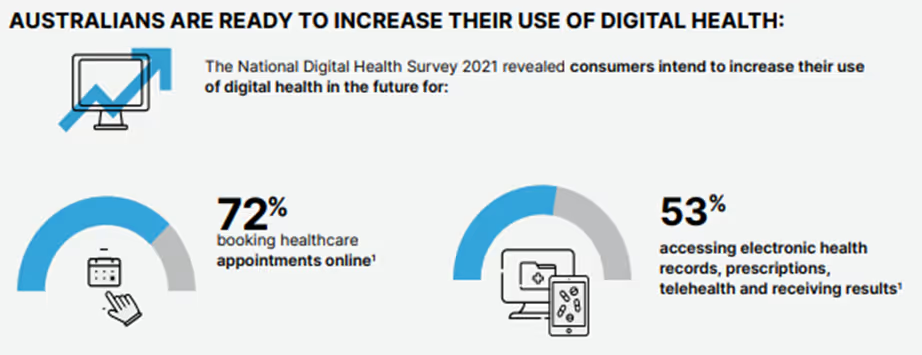
Australia embarked on its journey towards a digitally-enabled healthcare system in 2017 with the launch of the first National Digital Health Strategy. This sought to modernise the country's digital health infrastructure and make person-centred care a more inclusive experience - whether someone lives in a city or hundreds of kilometres from their closest hospital.
Central to this ambition is My Health Record, a mobile app where Australians can access and manage their health info, order prescriptions, and find resources related to their conditions and health risk factors. It proved extremely effective.
The number of Australians with an active My Health Record surged from 5.39 million in 2019 to 23.42 million in 2023. And during the pandemic, the easy sharing of clinical documents facilitated over 118 million telehealth GP appointments - pretty useful for social distancing!
The National Digital Health Strategy: Phase 2
It's the second phase of the National Digital Health Strategy, launched in 2023, that's truly ushered in a new era of patient-centred care.
This strategy prioritises a "standards-based approach" to medical practice in Australia, with a new interoperability framework for digital health tools and comprehensive training platform for workers in the industry. This means, no matter what health providers a person uses, everything is running on the same data, systems, and policy guidance for better care management.
Throughout the Digital Health Strategy Roadmap, the Australian government has consistently used public consultation platforms to gather feedback on proposed changes to My Health Record. One notable survey, powered by Citizen Space, asked patients how soon they'd like to receive results from medical tests - either immediately in the app, or 7 days later when a doctor could talk them through it. Overwhelmingly, people wanted to see results immediately, and the changes were swiftly rolled out. This collaborative approach to public service delivery with an emphasis on individual patient preferences can best be described as co-design.
Regional differences in patient-centred care
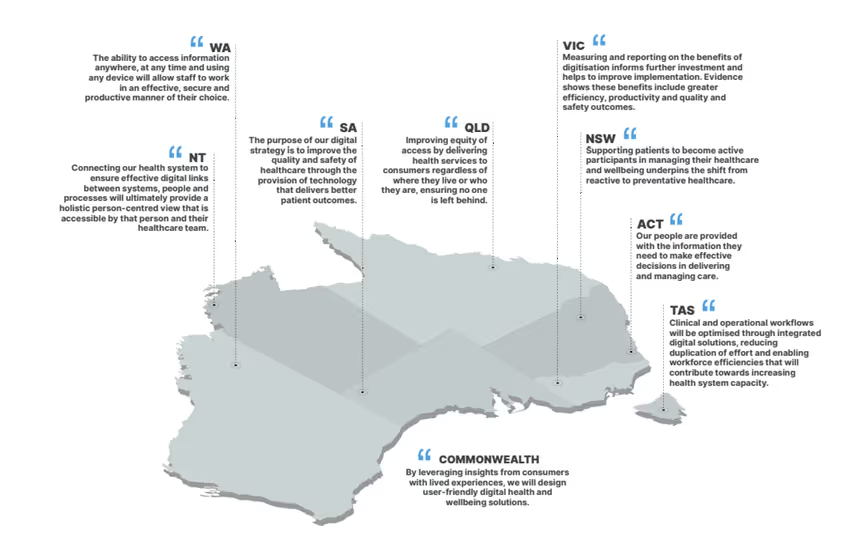
While all Australian states and territories are signatories to the NHRA, there are of course some regional variations in how this framework is applied in practice. This is to be expected, given the diversity of such a large nation with pockets of high-density populations, deprivation, and inequality.
It's why digital health infrastructure is developing slightly differently across the country.
For instance:
- New South Wales utilises its Single Digital Patient Record
- Victoria boasts its Health Information Exchange platform
- Queensland relies on its integrated electronic Medical Record (ieMR).
There are also targeted regional strategies for different health categories and ailments, such as the Northern Territory's Kidney Care system.
One of the most prominent case studies in regional patient engagement comes from the Aboriginal and Torres Strait Islander communities. Here, Australian healthcare works slightly differently, with services jointly-delivered (and scrutinised) by Aboriginal Community-Controlled Healthcare Organisations.
In particular, these groups helped co-design aspects of data collection for the NHRA and Digital Health Strategy. Their feedback meant culturally relevant determinants of health - like access to housing, education, and employment - are also used to understand patient outcomes and healthcare delivery in Aboriginal communities.
How the new Aged Care Act used online consultation

The New Aged Care Act, slated to launch in July 2025, will consolidate the piecemeal legislation that currently serves elder care in Australia. The driving force behind these changes is Australia's rapidly ageing demographic - with the 65+ cohort projected to rise from 16.8% of the population in 2024 to over 20% in the 2060s.
This home truth doesn't necessarily mean health services will cost more money or struggle to meet people's needs. If the New Aged Care Act is successful, the administration of the elder care system should run more efficiently, with better care coordination. As such, its health promotion strategies should reduce the per capita usage of care services by elderly Australians.
Here's how the act looks from a legal perspective:
- The act will outline a Statement of Rights for older people accessing government-funded care - analogous to the existing, broader Australian charter of healthcare rights.
- It will create a single entry point for elder care services, with clearer eligibility requirements and a fairer assessment framework.
- It will strengthen the aged care regulator via a new regulatory model and accountability mechanisms for healthcare providers.
But achieving such a momentous change requires more than just legislative drafting. It needs active engagement and genuine collaboration with the people who will be most impacted: older Australians themselves, their families, carers, and healthcare services that provide such essential care.
As such, there has been a substantial amount of New Aged Care Act consultation to get the new system running smoothly as soon as possible. After gathering feedback from over 10,000 Australians, the government is fast getting an idea of how elder care services should be structured and delivered. Let's take a look at how this process was conducted:
Step one: The Aged Care engagement hub:

Firstly, the government launched a dedicated online platform to share key information with stakeholder groups - including the elderly, aged care providers, healthcare professionals, trade unions, medical researchers, and Aboriginal organisations.
The idea here is to inform at the point of the response; meaning people didn't need any pre-existing subject matter expertise, or to do any healthcare research, to reach a fair judgment of the proposals.
Step two: Foundations of the new Aged Care Act consultation:

The foundation consultation then asked big questions about the legal nature of the NACA, such as how the Statements of Rights should be worded and where it should fit into Australia's constitution. This took a largely prescriptive approach to law-making, i.e. defining what a law should look like.
During this 12-week consultation, a variety of methods were used to gather responses, including surveys, webinars, workshops, and roundtables. As per the standard consultation process, it used a mix of patient engagement software and offline engagement methods, making it highly representative of the general public's views. The responses were then shared with, and deliberated upon, by MPs and Senators during its final drafting phase in Parliament.
Step three: Exposure draft consultation

Once a final draft was released, the government launched a follow-up exposure draft consultation. This took a more descriptive approach to law-making, meaning that citizens had the chance to explain how specific legal provisions will actually affect them day-to-day.
Again, this consultation used a mix of online and offline engagement methods to make participation as inclusive as realistically possible.
Step four: Feedback reports

Finally, the government responded via detailed consultation reports. This proved they were listening to Australians, stating exactly how they weighed up the pros and cons of peoples' arguments to reach a well-reasoned conclusion for every proposal.
From this, they are able to make clinical decisions on care delivery based on patient values and the healthcare services available.
At each stage public consultation was instrumental in shaping Australia's National Digital Health Strategy and the future of patient-centred care in the Australian healthcare system. None of this is possible without robust citizen engagement that reaches as many residents as possible, in an accessible way.
Citizen Space is the go-to platform for governments to consult local people on public services. It supports everything you need for community engagement online, including quick polls, surveys, policy pages, geospatial mapping, and other deliberation exercises.
Book a free demo and we'll show you how it works in action.
-----