The purpose of citizens' assemblies & citizens' juries
Deliberative democracy is an incredibly effective way to make policy decisions that are well-considered, fair and representative. However, it is still an underused form of citizen engagement in most of the world. Many people haven't heard of a Citizens' Assembly or Jury, and even less are aware of exactly how they work. To make this form of engagement more common, it is vital that decision-makers understand how they work and how engagement platforms can simplify the process.
What is a citizens' assembly?

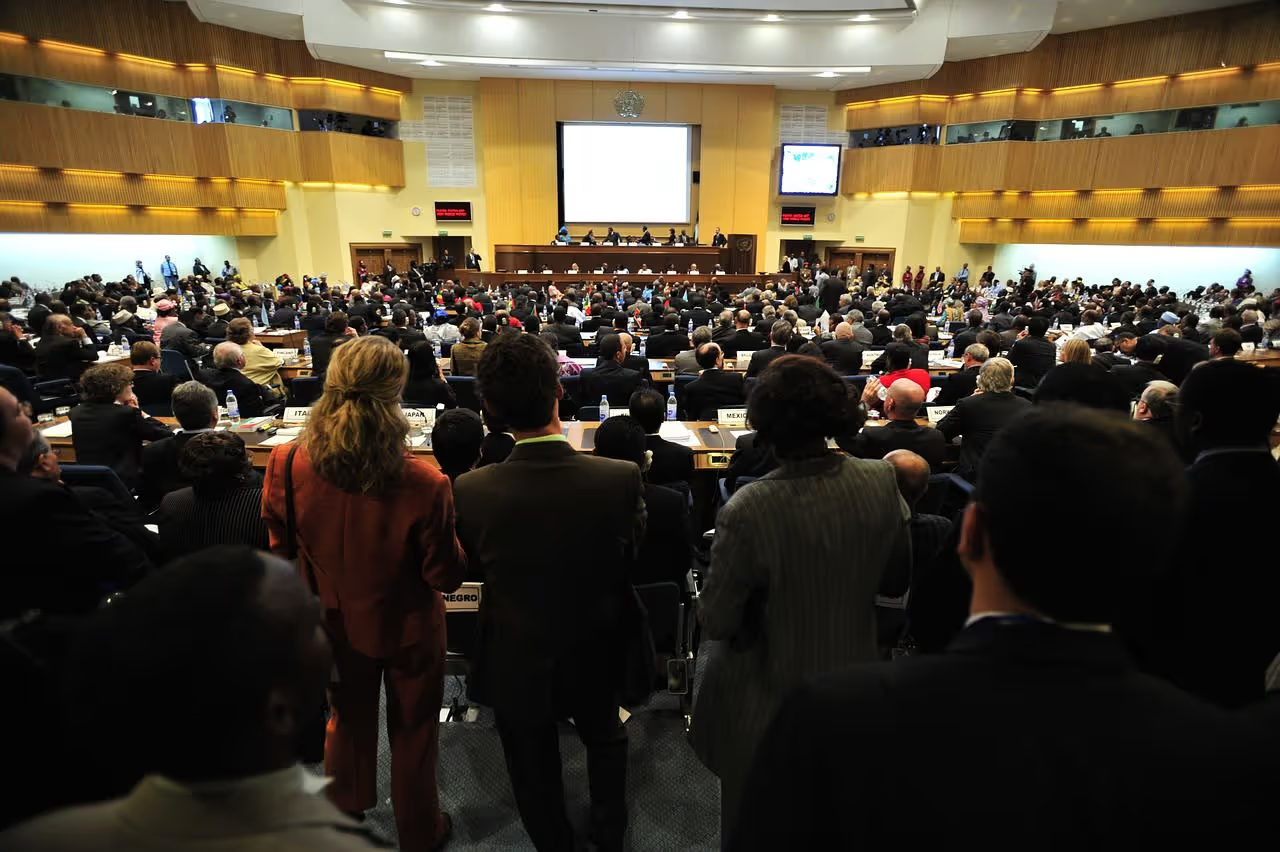
A Citizens' Assembly is an innovative and relatively new type of citizen engagement activity. It brings individuals together who are broadly representative of either specific communities or the country as a whole. The citizens chosen for this activity then learn about a given issue, and have opportunities to discuss, debate and deliberate on it.
The assembly can then make recommendations on this issue. It allows ordinary citizens to contribute to public policy, with their engagement aided by the contextual information provided and the support of experts. A well-run citizens' assembly should give participants access to a wide range of material, including relevant academics and industry experts. They should also be given adequate time to digest information and deliberate on it.
Citizens' Assemblies can vary considerably in size, but usually involve somewhere between 50 and 200 participants. Assemblies run over multiple days, and sometimes over consecutive weekends. The issues considered by Citizens' Assemblies are often very complex. They can be as far reaching as addressing societal inequality, or healthcare, or even global issues like climate change.
The purpose of a Citizens' Assembly is to provide informed and well-reasoned recommendations from a representative cross-section of the community.
What is a citizens' jury?
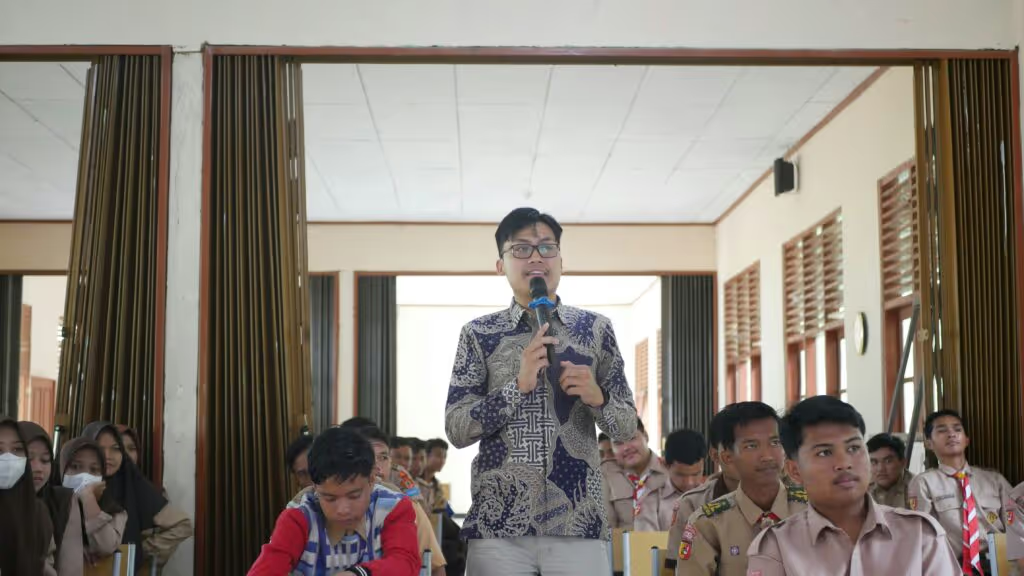
A Citizens' Jury is similar to an assembly but much smaller, with only 10-30 participants. It is run according to the same principles as a Citizens' Assembly, in that participants are encouraged to engage with a topic according to the principles of deliberative democracy. Participants still receive information, can discuss and debate amongst one another, and can then make a recommendation.
The key difference apart from the number of participants is in the types of issues that a citizen jury typically deals with. Whereas a Citizens' Assembly may deal with national or global issues, a Citizens' Jury tends to deliberate on local or community-specific issues. Due to their more limited nature, they often operate on a shorter timeframe such as a single day or even just one evening within a local authority.
They are often used by local governments in order to understand the views of a given community on certain policy recommendations or plans. Their more compact size and time-frame can make them more manageable than their larger scale counterparts.
Understanding deliberative engagement

Both Citizens' Assemblies and Citizens' Juries are forms of deliberative engagement, sometimes referred to as 'deliberative democracy'. Deliberative democracy is based on the idea that when people come together and discuss issues extensively, they can make effective decisions about the areas of policy that affect them and their communities.
Most political processes are inherently combative, involving opposing groups attempting to put across their point of view alone. Deliberative democracy instead seeks to create collaboration rather than conflict. In Citizen's Assemblies and Juries for example, each participant is encouraged to engage openly with all points of view, particularly those they may not otherwise have considered.
The deliberative process can only happen within an atmosphere of mutual tolerance, which can make it especially difficult when used for issues that are polarising or contentious. This is why it is essential that each participant is given equal access to information and that as much as possible is done to ensure all can understand that information.
Deliberate engagement requires careful planning and consideration that is discussed later in this article. However, the benefits are clear:
- Deliberative engagement helps to increase public trust in the decision making process. While this is true for almost all citizen engagement, deliberative engagement is one of the most hands-on and therefore can generate the most buy-in from participants.
- The quality of decision-making from assembly members and juries is often very high. It can help policy-makers to see proposals from angles they may not otherwise have considered, and encourage a more critical analysis of potential issues.
- It encourages the community as a whole to get involved in the democratic processes that affect their lives. Once they've seen how effective one is, they may want to get involved themselves. This has a ripple effect through the community.
- Communities themselves can be more cohesive if they feel a decision has been made that considers everyone. This is particularly useful in communities with different interest groups represented within it.
Choosing members for a citizens' assembly or citizens' jury

The selection of participants is one of the most important parts of ensuring a Citizens' Assembly or Jury is representative of the wider population. Many political processes tend to privilege the voices of certain groups over others, particularly the already politically engaged including partisans. By contrast, deliberative democracy aims to be more reflective of general political opinion.
The most common method for recruiting participants is via civic lottery. The usual method for conducting a civic lottery is as follows.
- Addresses are chosen at random from within the sample range (e.g depending on whether you want representatives from the whole country or a specific community).
- Those addresses are either sent letters or visited in person to explain what the assembly is and does, and ask for them to respond if they are willing to join a pool of potential participants. Some assemblies offer a small remuneration for participation.
- The respondents are added to a pool, which is then adjusted to be representative of society or the community being consulted.
- Participants are then randomly drawn from the pool and invited to take part.
To ensure that this process is fair and representative without being overly complicated to conduct, the process of drawing participants is usually conducted via a purpose-built digital engagement platform. This significantly reduces the resources necessary to ensure a representative sample.
Running a citizens' assembly
In order to run a successful Citizens' Assembly, it is important to plan carefully and have a clear strategy. Assemblies are large in scale and require time, resources and co-ordination to ensure they are inclusive and their results genuinely impactful.
To run one effectively, some important points for facilitators to remember are:
- Choose a topic that is not easily resolved through traditional consultation methods.
- Define the scope of the assembly early, so everyone understands the impact their recommendations can have.
- Recruit citizens that are reflective of the wider community they represent.
- Ensure that the assembly is accessible and inclusive for all participants. Consider using GovTech tools that can facilitate discussions online.
- Provide information that is as unbiased as possible. Invite industry experts to discuss the issue with participants, alongside any relevant individual who can help participants understand and participate.
- Facilitate discussions, ensuring everyone has a say and that the environment remains respectful and safe.
- Engage the wider public by sharing regular updates.
- Publish the results and effect of the assembly, to encourage future participation.
Running a citizens' jury
Running a Citizens' Jury has many of the same principles, however as it is smaller and more focused, there are a few additional considerations.
For example, it is easier to end up with a skewed sample of only majority demographics. It is just as important when juries are small - if not more so - that they are both representative and inclusive. This may mean that when selecting jurors, multiple attempts are made in order to get a representative sample that is still randomly chosen. Again, this is best done via specialised software.
Jurors should still be presented with experts and all relevant information. An issue with Citizens Juries is that their small scale can sometimes mean that this side of things is neglected. For Citizens Juries to work, the same effort to inform must be made by facilitators.
Finally, fewer people can make it easier for participants to be swayed by one or two "big personalities". It is therefore imperative that facilitators work hard to ensure everyone is heard, and that the group remains deliberative and open to ideas from everyone.
Examples of citizens' assemblies and juries

Citizens' Assemblies and Juries are very varied, covering a wide range of issues. Some examples of these include:
NHS England Citizens' Assembly: In 2014, NHS Citizen ran an assembly of 200 patients, carers, activists, volunteers and public sector workers. The group, split into five, discussed over 80 issues submitted through an online process. These included everything from service access to mental health to personalisation in healthcare. The conversations were constructive and useful, but the limited timeframe restricted what they could achieve.
This example went on to inform many other subsequent healthcare consultations.
Assembly North: In 2015, an Assembly was conducted in South Yorkshire by a large group of academics and the electoral reform society. They discussed the idea of devolution for the Sheffield City Region. This longer Assembly took place over two weekends, and ended with a series of recommendations including devolving tax-raising and law-making powers to the region. However, as the scope of power of the assembly was not agreed ahead of time, these policies were not incorporated.
Birmingham Museum Citizen Jury: In 2025, a Citizens' Jury was convened by Birmingham Museums Trust to consider what Birmingham needs from museums, now and in the future, and how the Trust could make that happen. As a result, they produced 20 recommendations that are now being acted upon.
Case Study: Scottish Climate Assembly

The Scottish Climate Assembly was commissioned by the Scottish Government in 2020. Over 100 citizens were invited to deliberate on how Scotland should respond to the climate emergency. Due to the COVID-19 pandemic, the national Assembly was conducted entirely online over the course of seven weekends. The online format made it possible for citizens to participate from all over Scotland, including more remote areas.
Participants were able to talk to experts and were asked to make recommendations on various policy areas, including land use, travel and diet. This Assembly went one step further, by broadening their reach to the wider public using Citizen Space. They were able to gather hundreds of comments that were then used to shape the Assembly's agenda. Some of the recommendations made by the Assembly were later adopted by the Scottish government.
"The general population has a genuine stake in the outcomes of the Assembly and therefore it is important they have the opportunity to have an input into its proceedings."
- The Scottish Climate Assembly
Citizen Space is the go-to platform for connecting governments, developers, and citizens. If you'd like to learn more about how our software supports deliberative engagement, book a free demo and we'll walk you through it.
Sign up for the Delib newsletter here to get relevant updates posted to your email inbox.