What human-centred design has to do with engagement

What is human-centred design?
But while human centred design principles take these into account, what human centred design actually is at its core, is a little more specific.
Simply put, human-centred design is a set of principles which involve taking an empathetic approach to service design. It means putting yourself in the shoes of whoever will be using a service to make sure it's as good, clear and straightforward as possible - a human centred approach.
It also means looking at the bigger picture: not just designing a service in isolation, but looking at the way in which it's linked to the surrounding systems and processes.
The best practices of human centred design for democratic processes:

- User experience: Is it easy-to-use, engaging and informative? Conducting user research to help understand the needs and behaviours of citizens that interact with government services, leads to informative design choices that improve the overall site design and UI.
- Stakeholders: Involve all key stakeholders via feedback on design processes to ensure all user needs are met.
- Accessibility: One of the most important human centred design principles is to ensure your service is accessible to all. This is particularly important to ensure that marginalised or vulnerable communities have a voice within the democratic process.
- Continuous improvement: The development of citizen engagement platforms like Delib's Citizen Space has provided greater accessibility to the general public in contributing to key government discussions. Using them, they can ensure their consultations and other democratic endeavours (like calls for evidence, spatial planning, climate response etc.) have a wider audience.
It seems obvious. Clearly, services should be designed for the people actually using them. But the reality isn't so straightforward, particularly not when we get into the public sector. Often enough, accessing certain council services can be anything but straightforward and seem to lack a human perspective.
But how did we get here? And why is it so seemingly uncommon to come across public services that just...work?
The problem with government and human centred design principles
- History/inertia: Systems or services worked in the past and the residual processes now dominate a service that might be poor or failing
- Bureaucracy: layers of management, alongside departmental silos and rigid, narrow job roles stifle innovation and create extra/unnecessary work
- Money: simply put, there isn't any, and radical change is expensive
[For an insightful, in-depth and interesting breakdown on why complex change is so darned difficult, there's no better resource than GCHQ's legendary Boiling Frogs report.]
Most government organisations aren't exactly rolling in dough. So public bodies do what they can, which often means sticking with something because it's just about good enough.
How to use human centred design in services

Of course, good, joined-up services are possible. The UK Government Digital Service (GDS) is a much-lauded example of how successful a radically disruptive programme of work can be, and its example has been used in government websites the world over.
Human-centred design, systems thinking, service design - all of these principles and methodologies require us to throw out the rulebook, reframe our approach to problem/solution, and start completely from scratch.
Unfortunately, as you might expect, for it to work this requires a significant initial investment into consultancy, training and technology (at the very least), scaled up across an entire organisation with thousands or even tens of thousands of staff. As we know, most government organisations aren't exactly rolling in dough. So public bodies do what they can, which often means sticking with something because it's just about good enough.
Fixing systems is a mammoth operation and it takes time. That absolutely doesn't mean there isn't good and valuable work that can be done to improve things in the meantime.
Human centred design and political engagement
Public consultations and deliberative democracy require human centred design as part of the principle of "least resistance". Making democracy human-centred means not burying information ten pages deep in a website with no search engine, not only accepting responses by email, and ensuring your consultation information is available far and wide, not just stuck on a lamppost in a certain neighbourhood.
The above are all common examples of ways government tries to encourage citizens onto the Ladder of Participation, without providing good design principles that support this.
When developing an engagement exercise, such as a statutory consultation, who it's aimed at needs to be considered in the development process.
Stakeholders, for example, may have more time to fill in lengthy and complex consultation documents than average citizens responding quickly between other tasks because this particular consultation affects their lives in some manner.
It's also essential to consider accessibility and human needs in the design process. All democratic processes should be able to be accessed and understood by all citizens. That's why citizen engagement platforms need to take a creative approach to solving complex problems and provide information in other ways than a pure data dump or large difficult PDF.
Asking yourself who will respond to an engagement exercise - and why - can have a huge impact on how you build it, and therefore how they navigate through your activity.
Human centred design and Delib
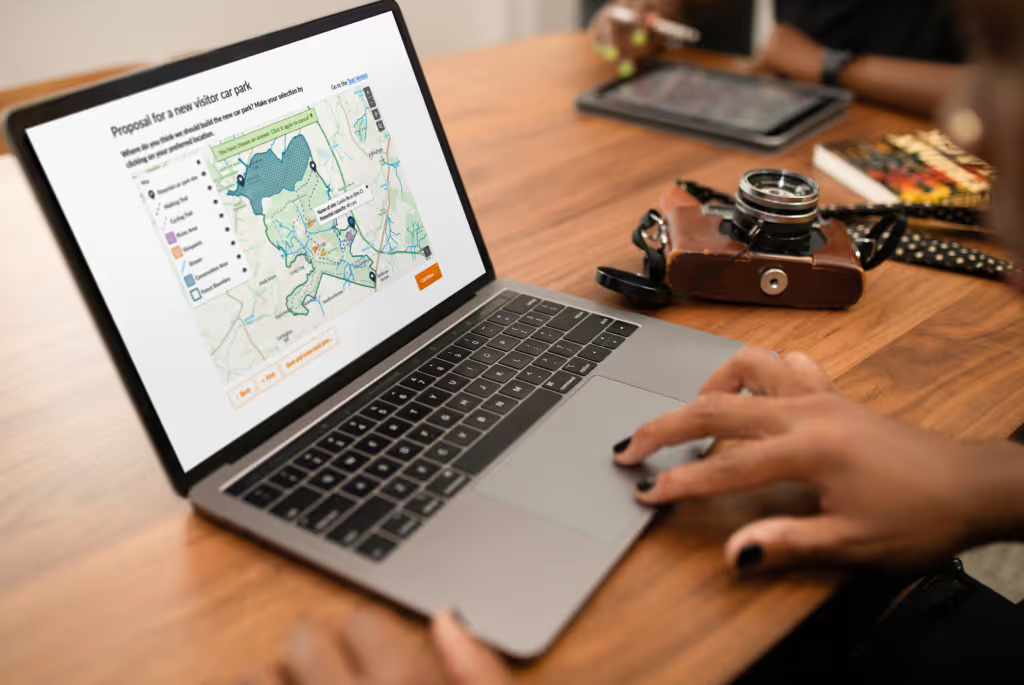
Putting users - humans - at the heart of our products is something Delib takes, and always has taken, very seriously.
Existing services for citizens who wanted to interact with democratic decision-making was, for the most part, poorly designed and dominated by outdated manual processes. Putting citizens first guides the design process of everything we do,
By engaging in an empathetic and considered way, public bodies get far more out of the whole process than by just publishing a document and asking for comments.
When questions are clear and concise and information is provided at the point of response rather than requiring prior knowledge, feedback becomes more nuanced and useful, leading to a greater social impact.
With human centred web design of citizen engagement platforms, you can make democracy accessible to all.
But beyond that, stakeholders and governments also benefit from:
- Increased response rates
- Improved and more well informed response rates
- Real engagement on the ladder of citizen participation
- Be able to generate ideas with positive, well received solutions
You can read a case study of how Police Scotland got a 500% increase in response rates after applying human-centred design principles to their community engagement processes.
While well-designed consultation and engagement processes won't magically fix an entire organisation, it can and does have a knock-on effect: good quality engagement breeds good quality data, which breeds good quality decision-making and more informed, human-centred policies that address peoples needs.
Check out our Good Survey Design webinar to learn how to apply human-centred design principles to your Citizen Space activity .