Experimental Traffic Orders at Europe's largest Local Authority

The challenge
With a population of more than a million people and some 21,000 staff, Birmingham City Council is Europe's largest local authority. Like many councils, Birmingham uses Experimental Traffic Regulation Orders (ETROs) to rapidly test new traffic and transport measures such as Low Traffic Neighbourhoods, pop-up cycle lanes and e-scooters.
Their approach is to enact an ETRO for an initial trial period, then a few months into its operation, ask the public for early impressions and feedback to inform decisions about whether to continue with the measure. This means running multiple consultations simultaneously across different wards and transport schemes.
The council needed a way to make it as simple as possible for residents to find, understand and give feedback on ETROs that were relevant to them, whilst ensuring staff could easily analyse and report on responses received. They also needed a consistent approach that would work whether handling a handful of local objections or thousands of in-depth comments.
The approach
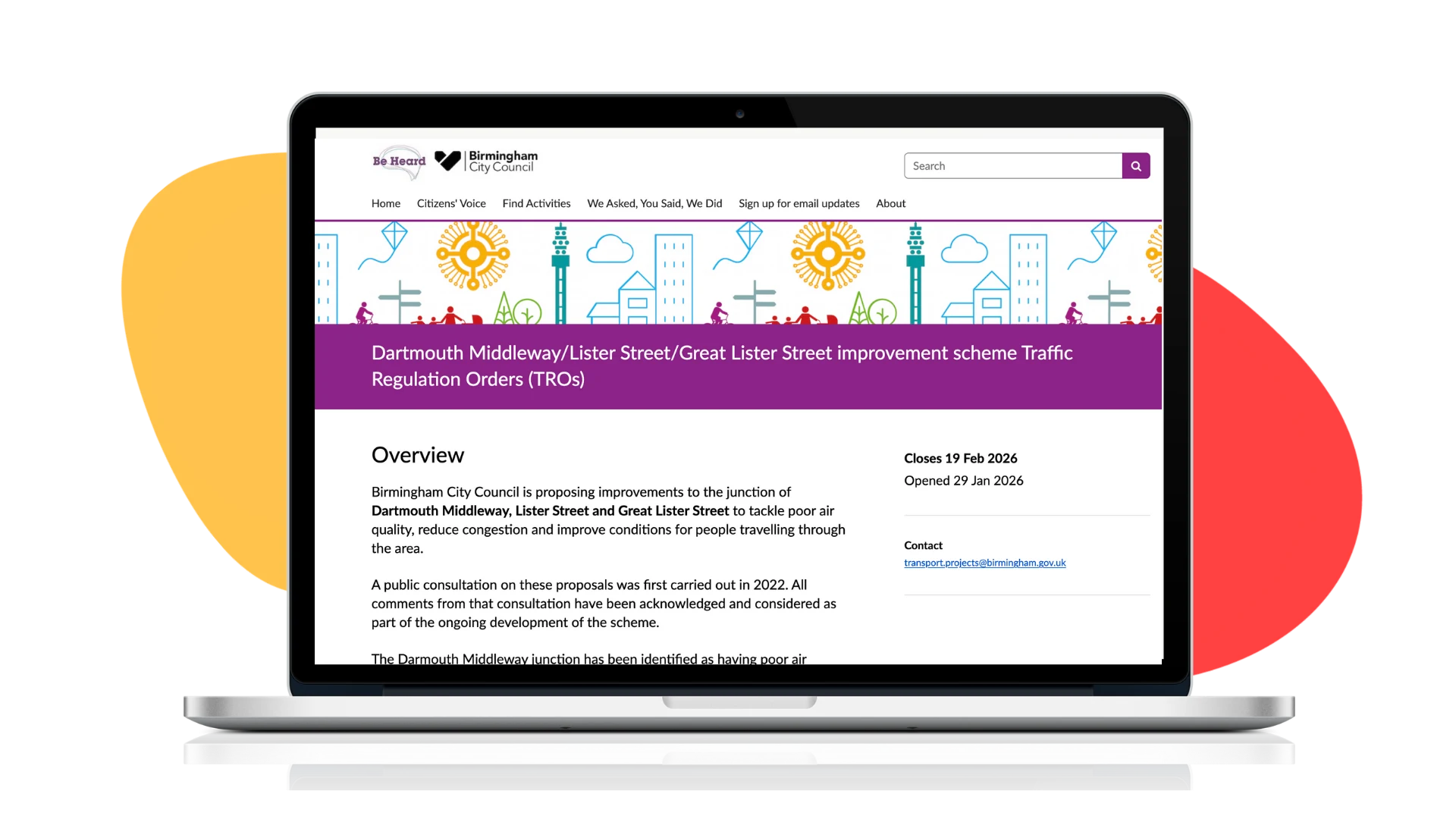
Birmingham adopted Citizen Space in 2011, bringing all their public engagement activity into their 'Be Heard' Hub. Since then, residents have been able to give feedback online on every single ETRO via the platform.
The council went out of their way to make participation straightforward:
Finding relevant ETROs: All Experimental Traffic Orders are listed on Birmingham's Citizen Space Hub with thorough titles, descriptions and categorisation. Residents can easily filter consultations by ward or area, and search by postcode or key term to find ETROs relevant to them.
Structured feedback: For every ETRO, Birmingham invites public feedback via online survey, allowing people to work through a guided series of straightforward questions rather than simply sending an email. This makes it easier for Birmingham to analyse responses and for the public to submit meaningful input.
Clear process: Birmingham ensures the ETRO feedback process is clear at every stage. Each consultation has prominent start and end dates, online surveys include progress bars showing where participants are in the process, introductions explain the difference between lodging an objection and making a comment with instructions on how to do either, and end pages set out in straightforward language how information will be used and what happens next.
This approach gives respondents confidence in the process whilst helping people actually complete and submit surveys, ensuring good completion rates.
The results
Birmingham City Council have used Citizen Space consistently since 2011 for ETRO consultations. The resulting familiarity for staff and expectation from citizens of participating online proved particularly valuable during the Covid pandemic, when in-person events and door-to-door surveys became impossible. The digital platform for public feedback became vital.
Whether handling a handful of local objections or thousands of in-depth comments, Birmingham has been able to make a consistent and convenient offer to over a million citizens to express their views online on transport measures affecting their area.

Citizen Space meets perfectly the part of our Consultation and Engagement Strategy requiring digital formal consultation. Our staff have taken to it easily and we have had overwhelmingly positive feedback.
Delib is a govtech leader specialising in consultation and engagement, trusted by over 600 government organisations worldwide, including major planning projects. Since 2004, we've been building secure, accessible digital platforms to make participation simpler, fairer, and more inclusive. Our flagship product, Citizen Space, was built in collaboration with the UK government and has supported more than 11 million responses across over 110,000 democratic activities.